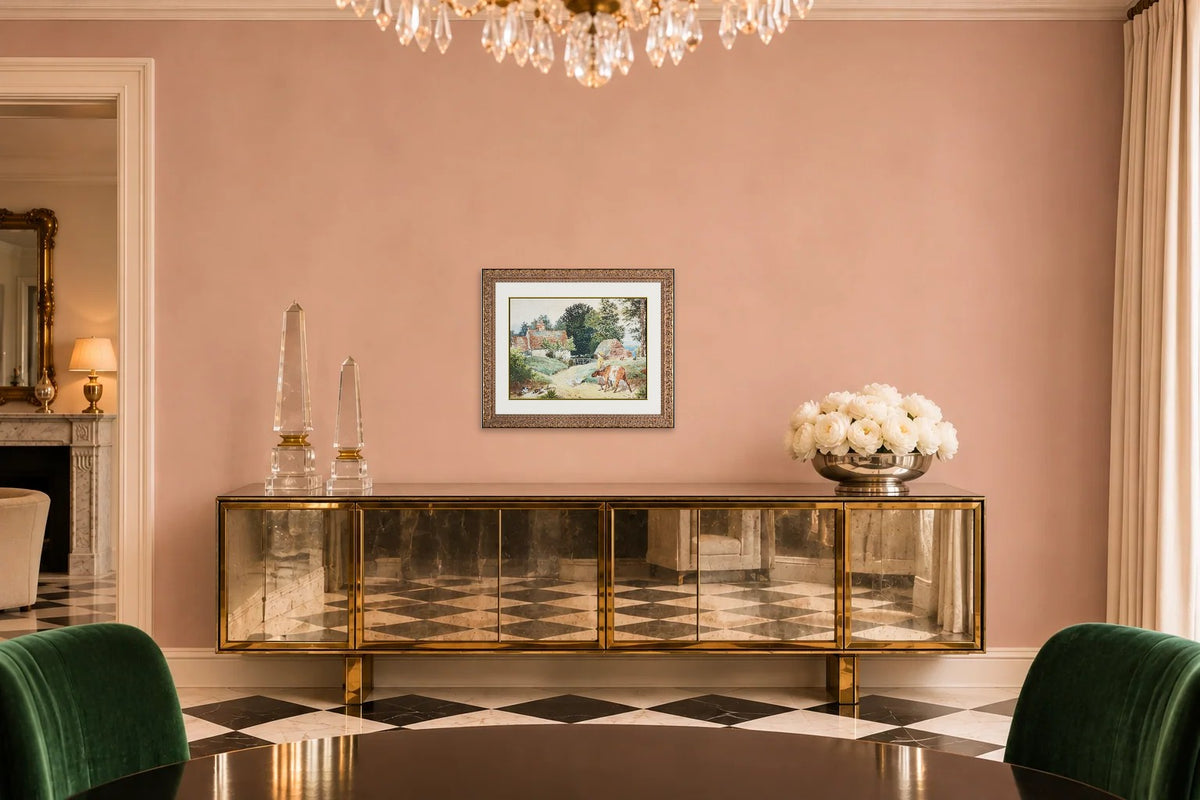
Victorian English watercolorist and illustrator, beloved for jewel-like scenes of the English countryside
English, 1825–1899
Myles Birket Foster was born on February 4, 1825, in North Shields, in the northeast of England, into a mainly Quaker family. In 1830 the family moved to London, where his father founded a beer-bottling business. Young Myles worked there at first, but his father soon arranged an apprenticeship with the wood engraver Ebenezer Landells.
Read more
In Landells' workshop he helped produce illustrations for Punch and the Illustrated London News, and he went on to become one of the busiest illustrators of his day, traveling around England for the Illustrated London News. His drawings for Longfellow's Evangeline (1849) and other books of poetry were a great success, and his "Christmas Holly Cart" was even taken up by makers of seasonal cards. Journeys along the Rhine in 1852 and 1854 produced an illustrated album of the river, published in 1856.
During the 1850s he taught himself to paint in watercolor, and success came quickly. In 1860 he was elected an Associate of the Old Watercolour Society, later the Royal Watercolour Society, and a full member in 1862. His engraver's training shaped his method. He began with a careful pencil drawing, laid in washes of transparent color, touched in patches of Chinese white and then worked over them in tiny stippled or hatched strokes of pure color. The result is a jewel-like finish, full of detail, at an intimate scale. He often sketched outdoors on small blocks he could carry in his pocket.
In 1863 he settled at Witley, near Godalming in Surrey, and built a house called The Hill, decorated with tiles and paintings by his friend Edward Burne-Jones and furnishings from William Morris's firm. The lanes, cottages and country people of west Surrey became his signature subjects: an idealized, sunlit English countryside that Victorian audiences adored, and that even critics who found it idealized praised for its detail and execution. He also traveled widely, painting in Scotland, along the Rhine, at the Swiss lakes and in Italy, especially Venice.
He married twice, first Anne Spence in 1850, with whom he had five children, including the painter and ornithologist William Foster, and then Frances Watson in 1864. In 1895 he was elected to the Berlin Academy. Ill health in 1893 forced him to sell much of his collection and move to Weybridge, where he kept on painting. He died on March 27, 1899, and is buried at All Saints' Church in Witley. The Times called him "certainly the most popular water-colour artist of our time." Our watercolor of a milkmaid in the English countryside is a classic example of the gentle rural world he made his own.
Why collectors love Myles Birket Foster
Foster's watercolors are small worlds you can step into: sunny lanes, thatched cottages and country folk, painted with astonishing detail. They have charmed viewers for more than 150 years, and they bring a gentle, timeless warmth to any room.
Known for
Victorian watercolors, idyllic English rural scenes, cottages and country lanes of Surrey, fine stippled technique with touches of white, book illustration
Highlights
- Apprentice to wood engraver Ebenezer Landells, illustrating for Punch and the Illustrated London News
- illustrated Longfellow's Evangeline
- Associate of the Old (later Royal) Watercolour Society (1860)
- built The Hill at Witley, Surrey, decorated by Burne-Jones and Morris & Co. (1863)