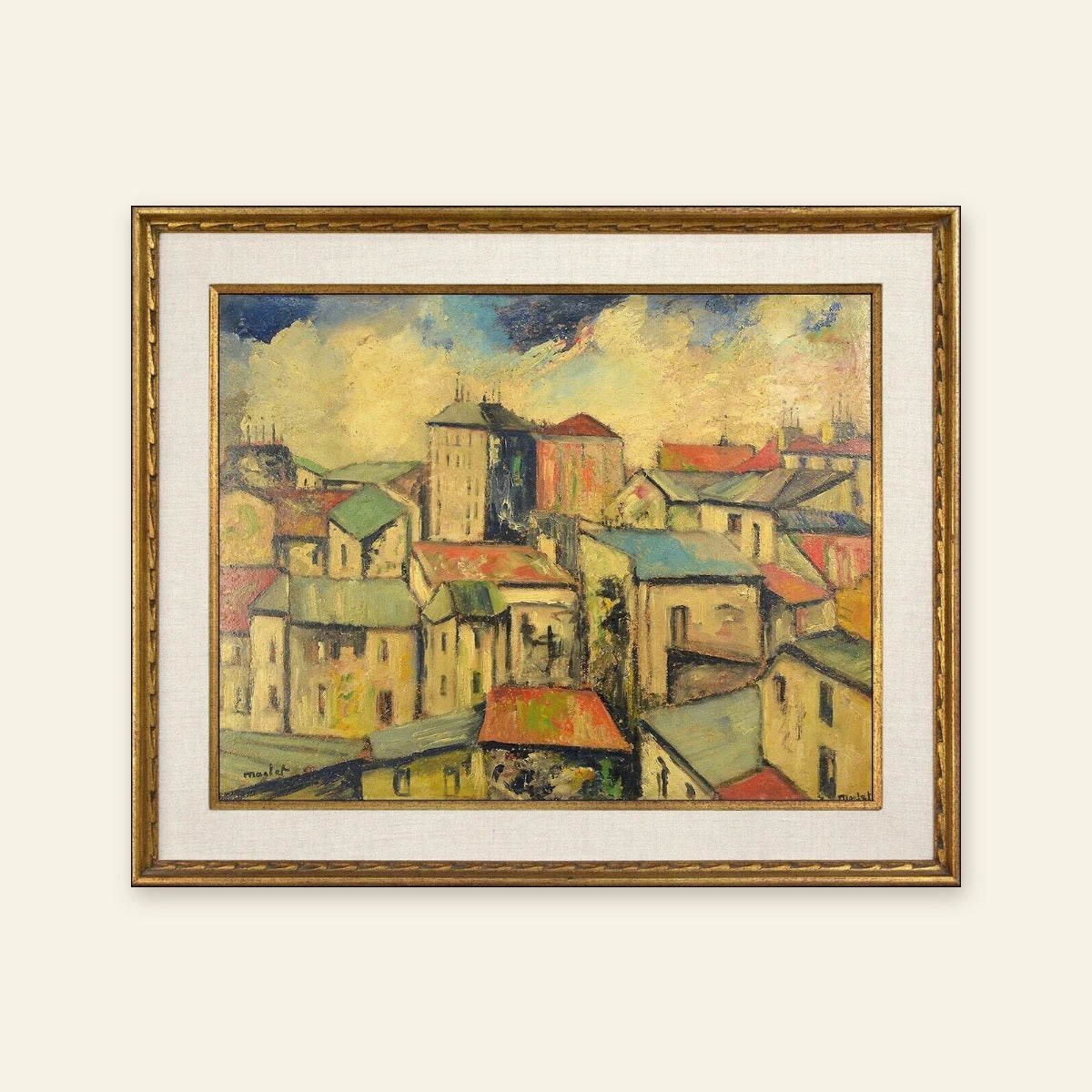
French painter of Montmartre, whose lively views of old Paris predate Utrillo's
French, 1881–1962
Élisée Maclet was born in 1881 in Lihons, a village in the Santerre region of Picardy, the son of a gardener and a laundress. His father was also sexton of the parish church, where young Élisée sang in the choir. The parish priest, Father Delval, was an amateur painter, and he took the boy into the countryside to sketch and paint. In 1892 the celebrated muralist Puvis de Chavannes saw some of the boy's work and asked to take him as a student. His father said no, and Élisée went to work beside him in the gardens.
Read more
In 1906, at 25 and against his father's wishes, he gave up gardening and moved to Montmartre. Like so many artists on the hill, he took whatever work he could find: varnishing iron bedsteads, washing dishes, opening oysters in restaurants and decorating floats for gala nights at the Moulin Rouge. In 1909 he even spent several months as a ship's cook on a voyage from Marseilles to Indochina. Back in Paris he painted the Lapin Agile, the Moulin de la Galette and the lanes of the old village, often in winter, leaving bare patches of canvas to suggest snow. He painted these corners of Montmartre several years before Maurice Utrillo made them famous.
Writers and dealers took notice. The poet and novelist Francis Carco became a patron, the writer Max Jacob wrote about him, and Colette was among his supporters. Père Frédé, owner of the Lapin Agile, gave him lodging, and the dealers Pierre Menant and Matho Kleimann-Boch hung his paintings beside works by Van Gogh and Picasso. During the First World War Maclet served as a medical attendant in a temporary hospital, and on leave he slept in the cabaret hall of the Lapin Agile, paying for his meals by washing dishes and polishing copper pots.
After the war his horizons widened. Carco sent him to paint the coast at Dieppe. Back in Montmartre in 1919, he recorded a changing city: new apartment buildings, the Ourcq Canal and laundry boats on the Seine. In 1923 a contract with an Austrian patron, Baron von Frey, took him to the south of France. For several years he painted the bright light and strong color of Provence and the Riviera, from Cassis and Antibes to Saint-Paul-de-Vence, Nice and Menton, and later Corsica and Brittany. After a Paris exhibition in 1928, museums in Lyon, Grenoble and Monte Carlo bought his paintings.
In 1933 Maclet suffered a serious mental illness from which he never fully recovered. Yet he kept painting, and after 1935 he returned to the Paris scenes he loved, now with a surer hand. A large exhibition in 1945, "Autour du Moulin," celebrated those subjects, and a retrospective in Paris in 1957 brought renewed attention to his work. He died in Paris in 1962 and was buried in Lihons, beside his parents.
Why collectors love Élisée Maclet
Maclet painted Montmartre as someone who lived it from the inside, a struggling artist sleeping in the back of the Lapin Agile rather than a visitor passing through. His views of the old village, with its windmills, cabarets and cobbled lanes, have a freshness and warmth that bring a lost Paris back to life. For anyone who loves the School of Paris, his work offers an intimate, authentic window onto the hill where modern art was born.
Known for
Post-Impressionist views of Montmartre and Paris, the Lapin Agile and Moulin de la Galette, snowy winter streets, sunlit scenes of the south of France, seascapes and floral still lifes
Highlights
- Painted Montmartre's landmarks several years before Maurice Utrillo
- supported by Francis Carco, Max Jacob and Colette
- paintings bought by museums in Lyon, Grenoble and Monte Carlo after his 1928 Paris exhibition
- Paris retrospective in 1957